What Is The Ranji Trophy? India’s Premier Red Ball Tournament
India’s first class championship has been running since 1934. Here is how the format works, who plays in it and why it still decides Test selection.
On This Page
- What Is the Ranji Trophy?
- History of the Ranji Trophy
- Ranji Trophy Format and Rules
- Ranji Trophy 2026–27: Teams and Groups
- Ranji Trophy Points System
- Most Successful Teams in Ranji Trophy History
- Who Won the Ranji Trophy 2025–26?
- Why Is the Ranji Trophy Important for Indian Cricket?
- Ranji Trophy vs Duleep Trophy vs Irani Cup
- Conclusion
- Frequently Asked Questions
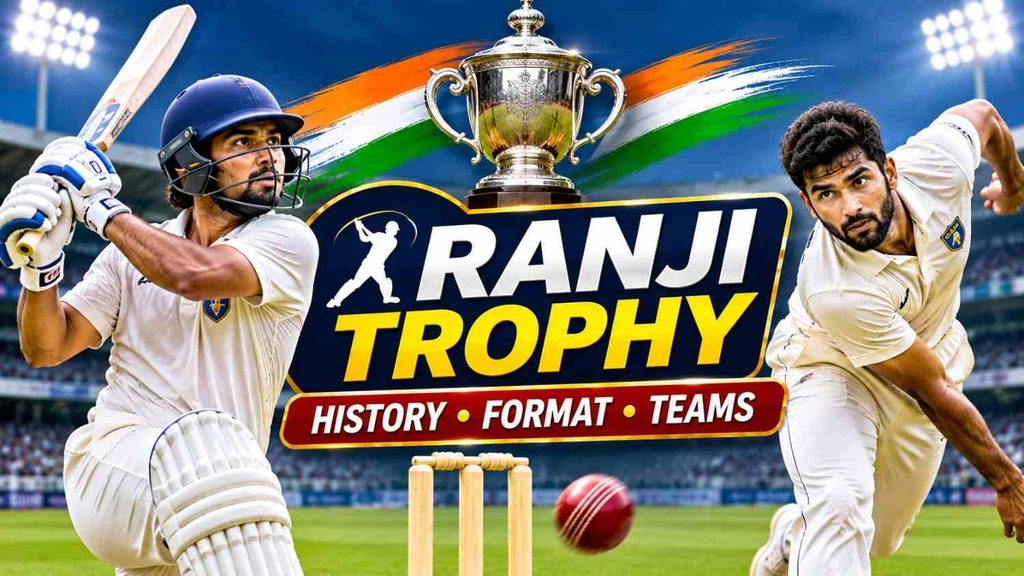
The Ranji Trophy is India’s premier domestic first-class cricket tournament. Organised by the Board of Control for Cricket in India (BCCI), it allows state and regional teams to compete for the national championship.
The tournament has played a major role in Indian cricket since 1934. Many famous Indian international cricketers, including Sachin Tendulkar, Rahul Dravid, Sourav Ganguly, Virat Kohli and Rohit Sharma, have featured in the competition.
Unlike the Indian Premier League (IPL), which focuses on T20 cricket, the Ranji Trophy tests a player’s technique, patience, fitness and ability to perform over several days. It remains an important platform for identifying and developing talent for first-class and Test cricket.
The competition features teams from different Indian states and cricket associations. Players get an opportunity to demonstrate their skills in longer-format matches and compete for one of India’s most respected domestic cricket titles.
Here is everything you need to know about the Ranji Trophy, including its history, format, teams, points system, latest 2026–27 status and most successful champions.
What Is the Ranji Trophy?
The Ranji Trophy is a domestic first-class cricket competition played between teams representing Indian states and cricket associations.
It is organised by the BCCI and played over multiple days using the traditional first-class format. Each team is generally entitled to bat in two innings, making batting technique, bowling consistency and match strategy extremely important.
The tournament is named after Kumar Shri Ranjitsinhji, popularly known as Ranji. He was one of the earliest Indian cricketers to achieve international recognition. He represented England in Test cricket and became famous for his elegant batting.
The competition allows domestic players to prove themselves at a high level. Strong performances can help cricketers earn selection for India and establish themselves in professional cricket.
History of the Ranji Trophy
The Ranji Trophy began in the 1934–35 season. The BCCI introduced it as India’s national first-class cricket championship.
The first match was played on 4 November 1934 between Madras and Mysore at Chepauk in Madras, now Chennai. Madras won the match by an innings and 23 runs.
Bombay became the first Ranji Trophy champion after defeating Northern India in the inaugural final.
The competition was named after Ranjitsinhji, who had died in 1933. Maharaja Bhupinder Singh of Patiala donated the trophy in his honour.
Over the years, the tournament expanded and its structure changed several times. More state associations entered the competition, and the BCCI introduced different divisions and group formats to make the championship more competitive.
Mumbai, formerly known as Bombay, established a remarkable record through its long period of dominance. The team won 15 consecutive titles between the 1958–59 and 1972–73 seasons.
The Ranji Trophy continues to be an important part of India’s domestic cricket structure. It has provided opportunities for generations of players to develop their skills and compete at a high level.
Ranji Trophy Format and Rules
The Ranji Trophy follows the traditional first-class format. Matches are played over multiple days, with each team generally having two innings.
The 2026–27 competition has two divisions: Elite and Plate. The Elite division contains 32 teams, while six teams compete in the Plate division.
The competition has league and knockout stages.
1. League Stage
The 32 Elite teams are divided into four groups of eight. Each team plays the other teams in its group during the league stage.
The six Plate teams compete in a separate group. Each Plate team plays the other teams in that group.
Teams earn points according to their match results. Their positions in the respective group tables determine qualification for the knockout stage.
The Elite and Plate divisions also provide a promotion and relegation route between seasons. The Plate winner earns promotion to the Elite division for the following season, while the lowest-ranked Elite team is subject to relegation under the BCCI’s rules.
2. Knockout Stage
The top two teams from each Elite group qualify directly for the quarter-finals. The winners progress to the semi-finals, followed by the final.
The 2026–27 Elite quarter-final pairings are:
- Elite A1 vs Elite C2.
- Elite B1 vs Elite D2.
- Elite C1 vs Elite A2.
- Elite D1 vs Elite B2.
The Plate competition has a separate knockout route. The top two Plate teams compete in the Plate final.
The Elite champion wins the main Ranji Trophy championship, while the Plate competition determines its own winner.
Ranji Trophy 2026–27: Teams and Groups
The 2026–27 Ranji Trophy is the 92nd edition of the competition. It began on 11 October 2026 and is scheduled to continue until March 2027.
There are 38 participating teams. The Elite division has 32 teams divided into four groups of eight, while six teams compete in the Plate division.
Elite Group Teams
| Group | Teams |
| Elite A | Baroda, Bihar, Goa, Jammu and Kashmir, Madhya Pradesh, Puducherry, Uttar Pradesh, Vidarbha |
| Elite B | Andhra, Assam, Chhattisgarh, Hyderabad, Karnataka, Punjab, Saurashtra, Tripura |
| Elite C | Bengal, Delhi, Gujarat, Jharkhand, Kerala, Maharashtra, Odisha, Services |
| Elite D | Chandigarh, Haryana, Himachal Pradesh, Mumbai, Railways, Rajasthan, Tamil Nadu, Uttarakhand |
Plate Group Teams
The six Plate teams for the 2026–27 season are:
- Arunachal Pradesh
- Manipur
- Meghalaya
- Mizoram
- Nagaland
- Sikkim
The BCCI uses promotion and relegation between the Elite and Plate divisions. Bihar entered the Elite division after winning the Plate competition in the previous season, while Nagaland moved to the Plate division.
The Plate winner of the 2026–27 season is scheduled to enter the Elite division for 2027–28. The lowest-ranked Elite team will move to the Plate division under the BCCI’s promotion and relegation rules.
Ranji Trophy 2026–27 Schedule and Latest Status
The 2026–27 competition follows a two-phase league schedule, with a break between the first and second phases.
| Stage | Schedule |
| Elite league phase 1 | 11 October – 5 November 2026 |
| Plate league phase 1 | 11 October – 5 November 2026 |
| Elite league phase 2 | 17 January – 4 February 2027 |
| Plate league phase 2 | 17–20 January 2027 |
| Elite quarter-finals | From 9 February 2027 |
| Elite semi-finals and final | February–March 2027 |
| Plate final | 24–28 January 2027 |
| Elite competition ends | 3 March 2027 |
Latest Ranji Trophy Status as of 28 November 2026
The first league phase finished on 5 November 2026. As of 28 November, the Ranji Trophy was on its scheduled mid-season break, with the next league phase due to resume on 17 January 2027.
The wider BCCI domestic calendar continues with limited-overs competitions during this period.
The four completed league rounds produced the following group leaders:
| Group | Leading Team | Matches Played | Points |
| Elite A | Vidarbha | 4 | 26 |
| Elite B | Hyderabad | 4 | 20 |
| Elite C | Maharashtra | 4 | 19 |
| Elite D | Mumbai | 4 | 27 |
| Plate | Sikkim | 4 | 15 |
Maharashtra led Elite Group C with 19 points, ahead of Bengal on 18 points. Maharashtra’s 10-wicket victory over Bengal on 2 November helped it finish the first phase at the top of the group.
Vidarbha and Mumbai also completed the first phase with four wins from four matches in their respective Elite groups. Sikkim led the Plate table with 15 points.
These are Phase 1 standings, not final tournament positions. Teams will have more league matches in the second phase before the knockout rounds begin.
The Elite quarter-finals are scheduled to start on 9 February 2027. The competition is due to conclude on 3 March 2027.
Ranji Trophy Points System
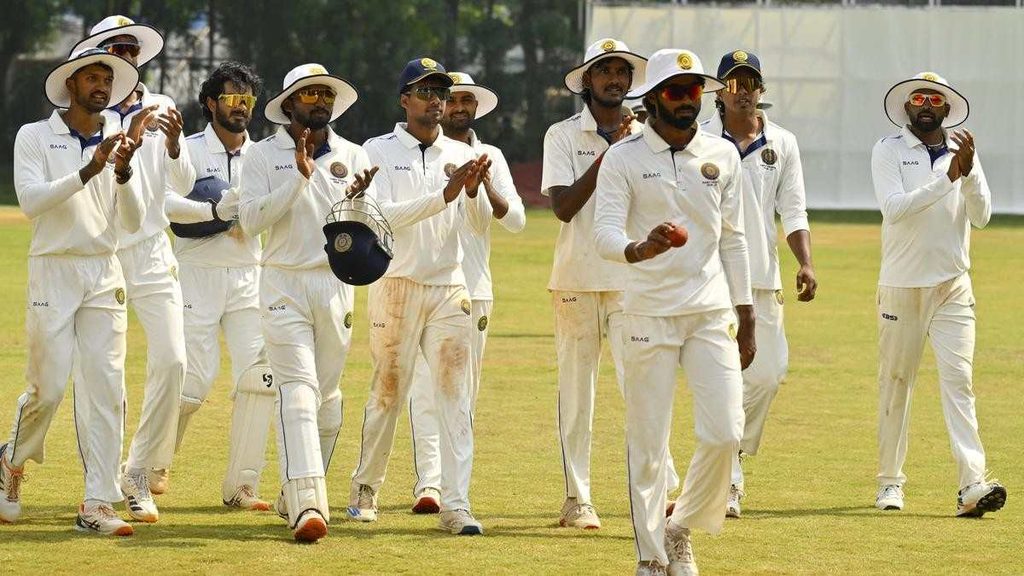
Source Image: Sportstar
The Ranji Trophy points system rewards teams for outright victories and first-innings performances. The BCCI’s 2026–27 playing conditions list the match-result points for senior multi-day competitions under Clause 16.9.1.
Match Result Points
| Match Result or Performance | Points |
| Outright win | 6 |
| Bonus for an innings win or win by 10 wickets | 1 additional point |
| First-innings lead without an outright win | 3 |
| Loss on first innings | 1 |
| Tie on first innings without an outright result | 1 each |
| Tie on both innings | 3 each |
| Outright loss | 0 |
| First-innings result not achieved because of weather or other unforeseen circumstances | 1 each |
An innings victory or a victory by 10 wickets gives seven points in total: six points for the outright win and one additional bonus point.
A team that secures a first-innings lead but does not achieve an outright victory receives three points. A team that loses on the first innings receives one point.
How Are Ranji Trophy Group Positions Decided?
Teams are ranked according to the points they earn from their league matches. The BCCI’s multi-day tournament ranking rules also identify bonus points, number of wins, head-to-head results where applicable and quotient as ranking considerations.
The one-point bonus for an innings victory or a win by 10 wickets is part of the match-result points system.
Important: The separate batting points for reaching 150, 225, 300, 350 or 400 runs and bowling points for taking 3, 5, 7 or 9 wickets are not part of the senior Ranji Trophy points table. Those additional batting and bowling points appear in the separate Col. C.K. Nayudu Trophy playing conditions.
This distinction matters because the Ranji Trophy and the under-23 Col. C.K. Nayudu Trophy do not use identical points tables.
Most Successful Teams in Ranji Trophy History
Mumbai is the most successful team in Ranji Trophy history. Its record of 42 titles is far ahead of every other team.
Karnataka and Delhi occupy the next positions, while several other teams have won multiple championships.
| Rank | Team | Titles |
| 1 | Mumbai and Bombay | 42 |
| 2 | Karnataka and Mysore | 8 |
| 3 | Delhi | 7 |
| 4 (joint) | Madhya Pradesh and Holkar | 5 |
| 4 (joint) | Baroda | 5 |
| 6 | Saurashtra, Nawanagar and Western India | 4 |
| 7 | Vidarbha | 3 |
| 8 (joint) | Bengal | 2 |
| 8 (joint) | Hyderabad | 2 |
| 8 (joint) | Maharashtra | 2 |
| 8 (joint) | Railways | 2 |
| 8 (joint) | Tamil Nadu and Madras | 2 |
| 8 (joint) | Rajasthan | 2 |
Historical team names are grouped where appropriate. Title totals include the 2025–26 season.
Mumbai’s dominance remains one of the biggest stories in domestic Indian cricket. Its 15 consecutive championships between 1958–59 and 1972–73 remain a remarkable achievement.
However, the competition has become more competitive as teams from different regions have developed stronger player programmes. Jammu and Kashmir’s maiden title in 2025–26 was another example of the changing strength of domestic cricket.
Who Won the Ranji Trophy 2025–26?
Jammu and Kashmir won their first Ranji Trophy title in the 2025–26 season.
They secured the championship against Karnataka in the final at the D.R. Bendre Karnataka State Cricket Association Stadium in Hubballi. The final was played from 24 to 28 February 2026.
The match ended in a draw, but Jammu and Kashmir won the title because they had secured a first-innings lead. Jammu and Kashmir scored 584 in their first innings, while Karnataka were dismissed for 293.
It was a historic achievement for the team. Jammu and Kashmir became the 20th team to win the Ranji Trophy.
Paras Dogra captained the side during its successful campaign. The victory also demonstrated the growing strength of domestic cricket teams outside the traditional title-winning associations.
Jammu and Kashmir entered the 2026–27 competition as defending champions.
Why Is the Ranji Trophy Important for Indian Cricket?
The Ranji Trophy is an important part of India’s cricket development system. It gives players experience in conditions that are different from limited-overs cricket.
Here are some reasons why the competition matters.
1. Pathway to the Indian Test Team
Strong performances in the Ranji Trophy can help players earn national selection. Batters must show patience and concentration, while bowlers need to maintain accuracy over long spells.
Consistent performances can help players demonstrate that they are ready for the demands of international cricket.
2. Development of Young Players
Young cricketers get an opportunity to compete against experienced domestic players. This helps them improve their technique, fitness and understanding of match situations.
They also learn how to handle pressure during long matches.
3. Preparation for First-Class Cricket
The competition teaches players how to manage long innings, bowl extended spells and recover between days of a match.
These skills are important for players who want to build careers in first-class and Test cricket.
4. Opportunities for State Teams
Every participating association gets a platform to develop its players and compete for national recognition.
The Elite and Plate divisions also provide a competitive structure through which teams can earn promotion or face relegation.
5. Testing Different Conditions
Players experience different pitches, weather conditions and playing surfaces across India. This prepares them for the variety of conditions they may encounter in international cricket.
Ranji Trophy vs Duleep Trophy vs Irani Cup
India has several important domestic first-class competitions. However, they serve different purposes.
| Tournament | Main Structure | Purpose |
| Ranji Trophy | State and regional teams | National domestic first-class championship |
| Duleep Trophy | Zonal teams | Competition between players representing different zones |
| Irani Cup | Ranji Trophy champions against Rest of India | Challenge match involving the previous Ranji champions |
All three competitions help assess players in the longer format. The Ranji Trophy remains the main state-level championship.
The Duleep Trophy provides competition between zonal teams, while the Irani Cup gives the previous Ranji Trophy champions an opportunity to face the Rest of India side.
Conclusion
The Ranji Trophy is the foundation of India’s domestic first-class cricket structure. Since its beginning in 1934, it has helped develop generations of cricketers and provided a pathway to international cricket.
Mumbai remains the most successful team with 42 championships, while Jammu and Kashmir created history by winning their first title in 2025–26.
The 2026–27 season features 38 teams across the Elite and Plate divisions. After the first league phase, Vidarbha, Hyderabad, Maharashtra, Mumbai and Sikkim led their respective groups.
The competition is scheduled to resume on 17 January 2027, with the Elite knockout stage beginning in February. For aspiring Indian cricketers, performing well in the Ranji Trophy remains an important step towards representing the country.
Frequently Asked Questions
The Ranji Trophy is India’s premier domestic first-class cricket tournament. It is organised by the BCCI and played between state and regional teams using the traditional multi-day format.
The Ranji Trophy began in the 1934–35 season. The first match was played on 4 November 1934 between Madras and Mysore.
Mumbai, formerly known as Bombay, holds the record with 42 titles. It is the most successful team in the tournament’s history.
Jammu and Kashmir won their first Ranji Trophy title in 2025–26. They secured the championship against Karnataka based on a first-innings lead after the final ended in a draw.
The 2026–27 season features 38 teams. There are 32 teams in the Elite division and six teams in the Plate division.