
BCCI Centre Of Excellence: Inside Indian Cricket’s New Hub
The board’s Bengaluru facility replaced the old National Cricket Academy. Here is what sits inside it and who it is built for.
On This Page
- What Is the BCCI Centre of Excellence?
- Where Is the BCCI Centre of Excellence Located?
- BCCI Centre of Excellence: Facilities and Infrastructure
- What Is the Role of the BCCI CoE in Player Rehabilitation?
- How Many Players Use the BCCI Centre of Excellence?
- BCCI Centre of Excellence Budget
- Can Fans Visit the BCCI Centre of Excellence?
- Why Is the BCCI Centre of Excellence Important for Indian Cricket?
- Conclusion
- Frequently Asked Questions
The BCCI Centre of Excellence (CoE) in Bengaluru represents a major step forward in Indian cricket’s training and player development system. Built to support cricketers at different stages of their careers, the facility brings professional coaching, specialist playing surfaces, sports science and medical support together at one location.
The Board of Control for Cricket in India (BCCI) inaugurated the new centre on 29 September 2024. Previously known as the National Cricket Academy (NCA), the facility provides Indian cricket with a dedicated campus for training, preparation and rehabilitation.
The centre is not just for established international players. It also supports India A, age-group and targeted players who need access to specialist coaching and performance services.
Here is a closer look at the BCCI Centre of Excellence, its facilities, purpose and role in Indian cricket.
What Is the BCCI Centre of Excellence?
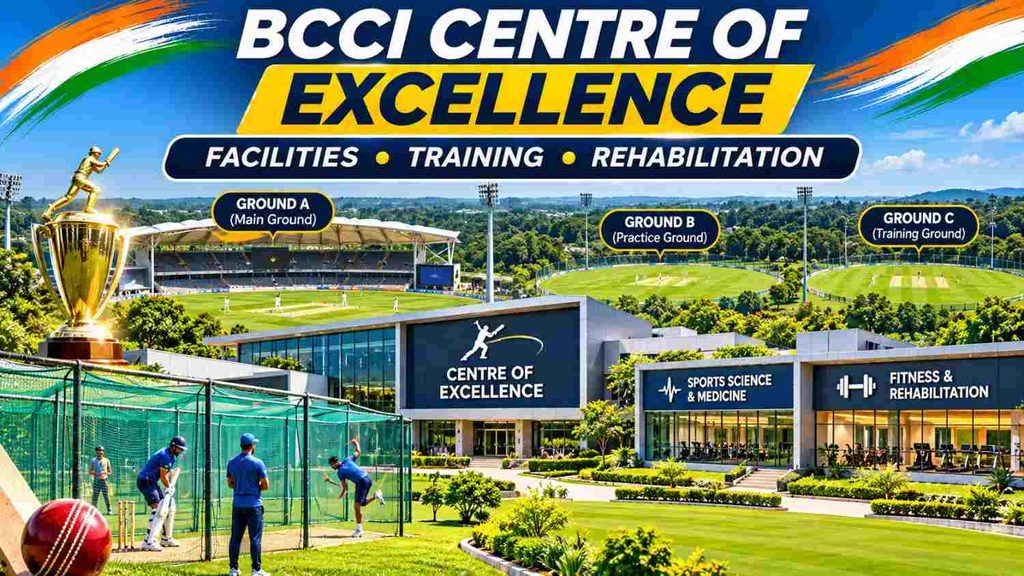
The BCCI Centre of Excellence is a high-performance cricket facility located in Bengaluru, Karnataka. It was previously known as the National Cricket Academy (NCA).
The BCCI developed the new campus to provide a wider range of facilities for Indian cricketers. The earlier academy operated from the M. Chinnaswamy Stadium premises, where space and ground availability could become challenging when several training camps ran at the same time.
The new centre brings multiple cricket grounds, indoor practice areas, outdoor nets, fitness facilities and medical services together.
The BCCI CoE is led by a system that connects coaching, sports science, strength and conditioning, physiotherapy and performance analysis. VVS Laxman serves as the BCCI Head of Cricket and plays an important role in the centre’s player development and performance programmes.
Its main objective is to help cricketers prepare for the demands of domestic and international cricket.
Where Is the BCCI Centre of Excellence Located?
The BCCI Centre of Excellence is situated on the outskirts of Bengaluru, Karnataka, near the city’s international airport.
The campus covers approximately 40 acres of land, with around 33 acres utilised for the facility. This dedicated space allows the BCCI to organise training camps, matches and rehabilitation programmes without depending entirely on an existing international stadium.
The centre also allows players to prepare for different playing conditions. Its grounds use different types of soil and surfaces to help cricketers adjust to conditions they may face during domestic and overseas matches.
BCCI Centre of Excellence: Facilities and Infrastructure
The BCCI CoE has three cricket grounds, a widely reported total of 86 pitches across indoor and outdoor areas, a sports science and medicine block and specialist training facilities.
| Facility | Details |
| Total campus area | Approximately 40 acres, with around 33 acres utilised |
| Cricket grounds | 3 |
| Total pitches | 86 widely reported; detailed published figures have a discrepancy |
| Outdoor practice nets | 45 |
| Indoor practice pitches | 8 |
| Main ground | Ground A |
| Sports science | Dedicated sports science and medicine block |
| Fitness facilities | Gym, running tracks and recovery facilities |
Pitch-count clarification: The overall figure of 86 pitches is widely reported. However, the BCCI’s 25th Apex Council meeting minutes recorded 13 pitches on Ground A, 11 on Ground B and eight on Ground C. Along with 45 outdoor practice pitches and eight indoor pitches, these figures add up to 85. The Indian Express reported nine pitches on Ground C, which produces the widely reported total of 86. The detailed ground-by-ground figures should therefore be treated with this source discrepancy in mind.
These facilities allow players to work on different aspects of their game throughout the year.
1. Three International-Quality Cricket Grounds
The campus has three main cricket grounds. Each ground has a different purpose and playing surface.
Ground A
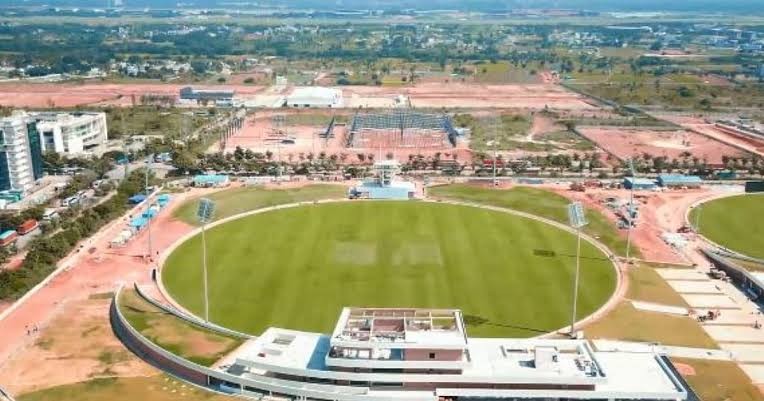
Ground A is the main ground at the CoE. It has 13 pitches made with red soil brought from Mumbai. The ground has an 85-yard boundary and facilities for hosting matches under floodlights.
It also has broadcasting arrangements and large dressing rooms. The BCCI can use this ground for India A matches and other important fixtures.
The red soil surface provides bounce and helps batters and bowlers prepare for conditions that may be found at several Indian and overseas venues.
Ground B
Ground B has 11 pitches made using local soil brought from Mandya in Karnataka. The surface combines red and black soil.
It has 75-yard boundaries and is mainly intended for practice. Its playing conditions give cricketers another type of surface to work on.
Ground C
Ground C has a black cotton soil surface sourced from Kalahandi in Odisha. It also has 75-yard boundaries.
Published reports differ on the number of pitches at this ground. The BCCI’s Apex Council meeting minutes recorded eight, while The Indian Express reported nine. The exact figure should be treated with this source discrepancy in mind.
Black soil surfaces can help players practise against different levels of bounce and movement. The ground is useful when preparing for conditions that differ from those on red soil pitches.
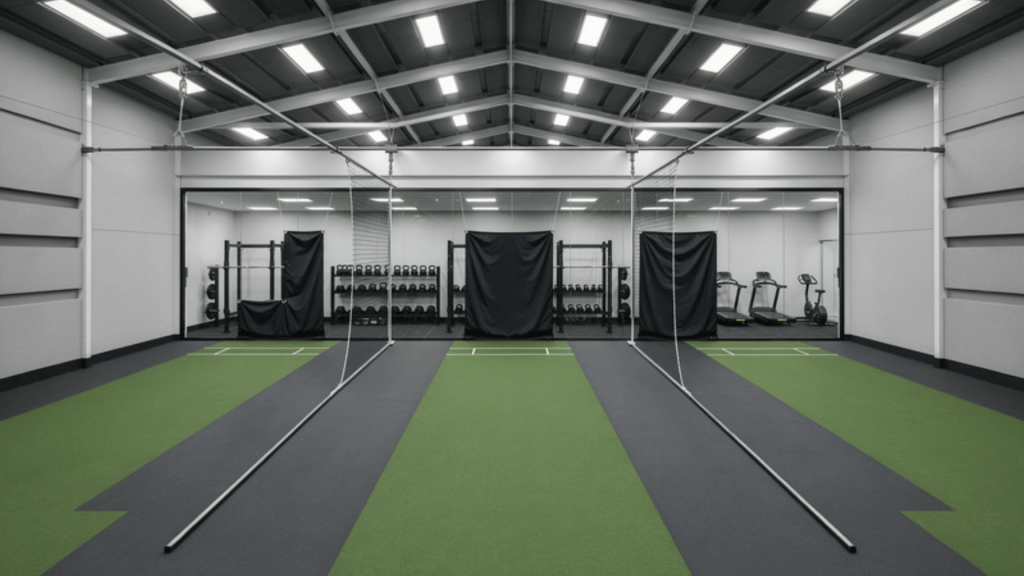
2. Indoor Practice Facility
The indoor training area has eight pitches with turf sourced from the United Kingdom and Australia.
The facility includes six pitches from the UK, with four designed for seam-friendly conditions and two for spin. Two additional pitches use Australian turf.
This allows players to practise on different surfaces without depending on outdoor weather conditions.
The indoor arena also supports technical training and skill development throughout the year.
3. Outdoor Practice Nets
The BCCI Centre of Excellence has 45 outdoor practice pitches arranged in nine clusters.
The practice areas include red soil, mixed soil, black soil and concrete surfaces. Some nets also have floodlights, allowing players to continue their sessions beyond daylight hours.
The variety of surfaces is important for batters and bowlers. Batters can practise against different types of bounce and movement, while bowlers can adjust their lines, lengths and variations.
4. Sports Science and Medicine Centre
The sports science and medicine block is one of the most important parts of the campus.
It supports player fitness, injury management, rehabilitation and physical development. Its services include physiotherapy, nutrition, strength and conditioning, recovery and performance assessment.
The gym covers approximately 16,000 square feet, according to the BCCI’s Apex Council meeting minutes. Some media reports have cited a figure of 16,200 square feet. The campus also includes recovery facilities such as a swimming pool, sleeping pods and running tracks.
These services help players prepare physically for demanding cricket schedules.
What Is the Role of the BCCI CoE in Player Rehabilitation?
Source Image: Free Press Journal
The BCCI Centre of Excellence plays an important role in managing injuries and preparing players to return to competitive cricket.
The process generally starts with an injury assessment and diagnosis. Medical professionals then develop a rehabilitation programme based on the player’s condition.
The programme may include:
- Medical assessment and specialist consultation.
- Physiotherapy and initial rehabilitation.
- Strength and conditioning work.
- Cricket-specific skill sessions.
- Gradual increases in training workload.
- Return-to-play matches and fitness assessment.
In an August 2026 interaction, VVS Laxman explained that players must meet established performance benchmarks before receiving fitness clearance. He said the process includes two return-to-play (RTP) matches before a player is declared fit.
The exact rehabilitation period depends on the injury and the player’s progress. A fixed recovery date cannot be guaranteed for every cricketer.
Workload Monitoring and Player Fitness
The CoE also monitors player workloads, particularly for fast bowlers and all-rounders.
Fast bowlers need enough preparation to handle the physical demands of competitive cricket. Increasing their workload too quickly can create problems, while insufficient preparation can also leave them unready for match demands.
According to Laxman, the CoE uses individual workload ranges and weekly monitoring for fast bowlers across different player groups. It also considers the additional physical demands on all-rounders, who need to manage both batting and bowling responsibilities.
The Athlete Management System (AMS) records training information. GPS technology also helps track player activity and workloads.
This information supports communication between the CoE, team management, medical staff and selectors.
October 2026 selection-meeting update
In October 2026, BCCI Honorary Secretary Devajit Saikia announced an important change in communication between the CoE and the national selection committee. He confirmed that VVS Laxman would attend all future senior men’s national selection committee meetings.
The decision followed a review meeting in Mumbai and was intended to prevent miscommunication between the selectors and the CoE. Laxman’s participation is expected to give selectors direct information about injured players, rehabilitation progress and fitness timelines when making selection decisions.
This development strengthens the CoE’s role beyond training and rehabilitation by improving coordination with India’s senior men’s selection process.
How Many Players Use the BCCI Centre of Excellence?
The BCCI CoE supports several groups of cricketers rather than only the senior Indian men’s team.
Its programmes can include:
- Centrally contracted Indian men’s players.
- Indian women’s team players.
- India A cricketers.
- Under-19 and other age-group players.
- Targeted players identified for specialist development.
- State association players attending selected programmes.
The BCCI’s August 2026 interaction highlighted the range of players using the facility, from Under-15 and Under-16 cricketers to senior men’s and women’s players.
A report published by The Times of India on 9 October 2026, citing the CoE annual report, stated that 32 leading men’s team players underwent injury rehabilitation between April 2025 and March 2026. This group included 20 centrally contracted players and 12 players from the targeted or India A category.
The same report stated that the CoE’s Sports Science and Medicine team treated or managed injuries involving 68 players across men’s and women’s cricket over a 20-month period.
These figures relate to injury management. They do not represent the total number of players who trained or attended programmes at the centre.
The CoE also continues to host age-group cricket. During November 2026, the BCCI Centre of Excellence hosted the Women’s Under-19 T20 Tri-Series involving India Under-19 A, India Under-19 B and Nepal Under-19.
The competition ran from 10 to 22 November, with matches played across CoE Grounds 1, 2 and 3. In the final on 22 November, India Under-19 B Women defeated India Under-19 A Women by five wickets at CoE Ground 1.
This demonstrates the centre’s continued use for organised age-group cricket alongside its training and rehabilitation programmes.
BCCI Centre of Excellence Budget
The Centre of Excellence requires significant investment to maintain its facilities, employ specialist staff and organise cricket programmes.
A report by The Times of India in October 2026 stated that the CoE’s actual expenditure for the 2025–26 financial year was approximately ₹92 crore. Its projected expenditure for 2026–27 was ₹127 crore.
| Financial year | Reported expenditure |
| 2025–26 | ₹92 crore actual |
| 2026–27 | ₹127 crore projected |
The projected increase is approximately ₹35 crore.
These expenses are not limited to injury treatment. They also include administration, coaching and performance programmes, courses and match-related expenses.
The figures were reported from the CoE annual report and should be understood as reported actual and projected expenditure, not as a separate rehabilitation budget.
Can Fans Visit the BCCI Centre of Excellence?
The BCCI Centre of Excellence is primarily a training and performance facility. It is not a regular public cricket stadium.
In August 2026, BCCI Honorary Secretary Devajit Saikia explained that restrictions linked to the land do not permit large crowds inside the campus.
This means fans cannot assume they can enter the facility to watch every match or training session.
The BCCI has increased the number of domestic matches being broadcast live to give supporters better access to cricket played at the centre. It has also moved an important fixture to a public stadium to allow spectators to attend.
On 19 August 2026, the BCCI confirmed that the Duleep Trophy 2026–27 final would be held at M.A. Chidambaram Stadium in Chennai, rather than at the CoE in Bengaluru. The decision was made to allow spectators to attend the final, which took place from 6 to 10 September 2026. The remaining Duleep Trophy matches were played at the CoE.
East Zone won the final against South Zone based on a first-innings lead after the match ended in a draw. The venue change allowed spectators to watch the final at a public stadium.
The decision demonstrates how the BCCI can use other venues when spectator access is required. However, the CoE itself remains subject to restrictions on large crowds.
Fans should check official BCCI announcements for match venues and broadcast information.
Why Is the BCCI Centre of Excellence Important for Indian Cricket?
The CoE gives Indian cricket a central facility for player development, preparation and performance support.
Its importance can be understood through several areas.
Better preparation for overseas tours: Different soil types and practice surfaces allow players to prepare for conditions they may face in countries such as Australia, England and South Africa.
Support for young cricketers: Age-group and targeted players can access specialist coaching and performance services. This helps strengthen the pathway from junior cricket to senior teams.
Improved injury management: Medical and rehabilitation facilities help injured players work towards a structured return to competitive cricket.
Performance development: Coaching, fitness testing, workload monitoring and skill analysis support continuous improvement.
Better communication with selectors: VVS Laxman’s participation in senior men’s selection committee meetings helps improve communication about player injuries, rehabilitation progress and fitness availability.
Support for women’s cricket: The centre’s facilities and performance programmes are also intended to benefit Indian women’s cricket. Its use for the Women’s Under-19 T20 Tri-Series in November 2026 is one example of its role in age-group cricket.
The CoE cannot prevent every injury or guarantee success at international level. Its value lies in providing players and support staff with better facilities and more organised processes.
Conclusion
The BCCI Centre of Excellence is an important part of India’s cricket development system. Located in Bengaluru, it brings three cricket grounds, a widely reported total of 86 pitches, indoor and outdoor training areas, a large gym and sports science services together on one campus. The published pitch breakdown has a small discrepancy, with the BCCI’s detailed figures adding up to 85.
Its role goes beyond rehabilitation. It supports young talent, senior cricketers, India A players and women’s cricket through coaching, fitness, workload monitoring and specialist medical care. It also hosts domestic and age-group matches, while spectator access remains restricted.
Recent developments have strengthened its role in Indian cricket. These include the October 2026 decision for VVS Laxman to attend senior men’s selection committee meetings and the centre’s continued use for domestic and age-group competitions.
As Indian cricket continues to manage a demanding international and domestic schedule, the BCCI CoE will remain an important facility for preparing players and improving performance standards.
Frequently Asked Questions
The BCCI Centre of Excellence is a high-performance cricket facility in Bengaluru. Previously known as the National Cricket Academy, it provides coaching, training, sports science, fitness and rehabilitation support to Indian cricketers.
The BCCI CoE is located on the outskirts of Bengaluru in Karnataka, near the city’s international airport. Its campus covers approximately 40 acres, with around 33 acres utilised for the facility.
The facility is widely reported to have 86 pitches across indoor and outdoor areas. These include 45 outdoor practice pitches and eight indoor pitches, along with pitches on its three main grounds. However, the BCCI’s detailed ground-by-ground figures add up to 85, while The Indian Express reported one additional pitch on Ground C.
The centre supports senior Indian men’s and women’s players, India A cricketers, age-group players, targeted players and selected state association cricketers. Access depends on BCCI programmes and selection.
The CoE is not a regular public stadium. Restrictions linked to the campus do not permit large crowds. The BCCI moved the 2026–27 Duleep Trophy final to Chennai to allow spectators to attend, while the other matches were played at the CoE. Fans should check BCCI announcements for match broadcasts and venue information.